13 January 2012

Life After Mercy Ships

A lot has happened since last summer not the least of which is that I am now sitting at a computer in Germany thinking about buying beds and painting :)
Last year, Marcel and I began to think about what comes next and really felt that God was leading us to leave Mercy Ships and see what he had for us in Germany. Although it was not an easy decision, Marcel had job interviews in October and was able to find a great job in the city of Munich in southern Germany. Not only is this a great international city, but also close to the Mercy Ships office in Kaufbeuren and friends in Munich.

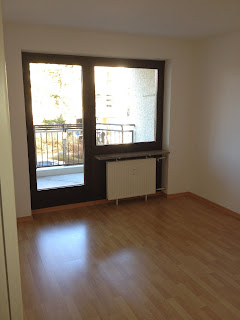
Last week we were able to find an apartment just outside of Munich (Unterschleissheim) which is still only about 20 minutes from Marcel's work and has all the things we were looking for . . . 'wood' floors, a balcony, room in the kitchen for a larger frig/freezer and a table, a bathroom with a connection for a washing machine in the future . . . We have signed the contact and are waiting now for the renter to countersign. If all goes well, we should have the key by the 20th and move in that weekend. This is a real answer to prayer as we had heard that it could take months to find a good place and I am really looking to unpacking and not having to pack it up again in a few months. We are currently living in a small apartment owned by Mercy Ships which has been a great blessing in getting started here, but not quiet our own and it is hard to know what to unpack when we were unsure of how long we would be here.

Anyhow, some pictures taken with my phone yesterday - not the best, but give an idea of the space - kitchen, bedroom, living room, balcony, bathroom and small entrance way with closet. If you can imagine, the kitchen, living room and balcony are all along the front of the apartment and then the bathroom, entrance way and bedroom run along the back. The balcony 'pushed' the bedroom back a little from the front 'wall' and the entrance way and bathroom 'push' the living room and kitchen to the front.

kitchen
living room
bedroom
balcony
bathroom
turn around from the bathroom and there is the closet and front door - the door all the way across is to the bedroom

24 July 2011

Changing Lives Through Agriculture

Although the focus and strength of Mercy Ships is the medical that it can provide in West Africa, we also have an agricultural programs that is changing lives in other ways. The stories that come from this agricultural training every year are amazing. Teaching wise farming techniques and God's charge to man to be good stewards of the land is literally reaping harvest in countries (and lives) that have been barren for a long time. This is just one story from here in Sierra Leone written by the Communications Department.

Bambay is an extraordinary individual, whose life’s goal is “not to be a beggar.” This reflects the reality of life in Sierra Leone after their brutally violent ten-year civil war. The conflict devastated the people and left the country in shambles and poverty.

During the war, Bambay, his mother, and two younger siblings fled from their village and hid in the bush for a month. When they ran out of food,
Bambay went back to his village to find something – anything – they could eat. He planned to return to his family that day, but it was late. So, he accepted an invitation to stay until the next morning. It was a disastrous decision.

During the night, the village was attacked by rebel soldiers. “You voted
for this president!” they shouted. Bambay tried to explain that he was only 15 and couldn’t vote for anyone. But they wouldn’t listen. They chopped off both his hands and left him for dead . . . along with the other villagers who had been mutilated.

Later that day, he was found by a roving seller of goods and taken to a nun at a nearby church. She took him to a hospital and then nursed him back to health. While Bambay was in her care, she asked him what he’d do if he ever found the man who cut off his hands. “I would kill
him!” said Bambay.

The nun began to plant the seeds of forgiveness into Bambay’s thinking. She told him how important it was for his future to relinquish the hate and anger that fueled his unforgiveness.


The nun also did what she could to prepare the young man for life on his own. She
arranged a surgery that would split the hacked ends of both hands, allowing him to grasp things.

One day Bambay was out with his friends when he saw “Sewer Poison,” the nickname given to the man who had cut off his hands. He went after him and caught him, but couldn’t bring himself to kill the man. The seeds of
forgiveness had been well-planted. His friends offered to kill the man for him, but Bambay wouldn’t allow it. The man pleaded for his life, and Bambay forgave him.

That forgiveness enabled Bambay to move on with his own life. He eventually met and married Mary, and today they have a seven-
month-old baby daughter, Ann.

Today, Bambay is a trainee in the Food for Life Program that was started in Benin by Mercy Ships and Bethesda, another non-governmental organization. The goal of the program is to train people in organic farming methods and in leadership principles. These trainees will, in turn, teach others in their communities. In this way, the program is duplicating easily in Sierra Leone. It has the potential of transforming food-growing in the country, as it improves the financial status of those involved.

The Food for Life program is also partnering with City of Rest
Rehabilitation Center’s Agriculture Therapy and Skills Training program.

Bambay wants to be involved in using the program’s biblical concepts to help rehabilitate the mentally ill, as well as drug and alcohol
addicts Bambay is, indeed, a remarkable man who is achieving much, much more than his goal to “not to be a beggar.”


Story by Elaine B. Winn

Edited by Nancy Predaina

Photos by Tom Bradley and Ken Winebark

04 July 2011

Creative Ideas to Help Patients

Another story from the Communications Department about some of the great ideas that arise from necessity.

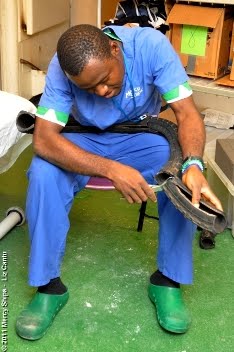
“NECESSITY IS THE MOTHER OF INVENTION,” so the old adage goes. Nowhere is it more apparent than in the physiotherapy department onboard the Africa Mercy. When patients’ legs are put in casts, they can’t wear shoes – but they can’t go barefoot, either. The Rehabilitation Team has found a suitable, inexpensive, and easily available way to give each patient the foot protection needed during their recovery. The answer is . . . tire shoes.

Anama Latta, a day-worker in physiotherapy, is responsible for producing shoes from tires in various sizes to accommodate patients. He gathers old tires from motorbikes and begins by removing the wire inside with a knife.
Then he measures for sizes – 10” for large, 6” for medium, and 4”| for small. Using a box cutter, he cuts incisions to mark where he will use the scissors to cut through. Next, he cuts three holes on each side. Then proper lengths of polypropalene ribbon are used to tie the shoes on.

Anama says the tire shoes are stronger than other footgear they might use, and they provide more protection on the sides of the foot. “When I was a child in Togo, I used to wear shoes like these to go to my Daddy’s farm,” said Anama. “They protect better than flip-flops, and the cast doesn’t get wet.”


Tire shoes last longer than ordinary shoes, and patients can walk easily in them. Anama says he enjoys making the tire shoes. “This is the way I can help them (the patients and the Rehabilitation Team), and I’m happy to make them.”


Story by Elaine B. Winn
Edited by Nancy Predaina

Photos by Liz Cantu

27 June 2011

Beaches

So if you ever happen to be in Sierra Leone and someone says - 'Want to go to the beach?' - jump at the offer. Brave the hours of traffic jams, put on your suit and go.

Marcel and I were slow to actually get to the beach this outreach -- by the time the weekend gets here I normally just want to sit and do nothing or I am trying catch up with the past week to get ready for the next one. But a couple of weeks ago we were invited to go out and realized that the trouble of getting there (45 minute trip without traffic, a couple hours with) was well worth a day of sitting on white sands and warm waters. Most places also offer lunch for a reasonable price - usually freshly caught fish with chips or rice. At one place we had sweet potato fries that were great. White sands, warm water, plenty of space to spread out, little huts that really do keep out the always present rain during rainy season . . .
Now that rainy season has started, we will have to see how often it is clear on the weekend, but now that we know what is there, we are ready to go again.


19 June 2011

A Story of God's Faithfulness

This story happened about 2 months ago and was written by our Communications Department - just another reminder of God's perfect timing.

Two-year-old Josephine inhaled something that affected her breathing. Her parents, David and Judith, could hear the rattle with every struggling breath. They took her to a local clinic which sent them to an emergency hospital . . . which sent them to a government hospital . . . which sent them to a satellite clinic . . . which sent them back to the government hospital. After five days in the government hospital, specialist Dr. Karim Kabineh told them that Josephine was so tiny that she would die if he performed the necessary operation. He needed a pediatric anesthetist, anesthesia equipment, and a critical care unit with 24-hour nursing care – all unavailable at that hospital.

After eight days of hopeless searching for help, the desperate parents took Josephine to the office of the Minister of Health, where David hoped to plead his case and find someone who could help. At that moment – in the miracle of God’s timing – Ann Gloag, a member of the Mercy Ships International Board who is well-known for her charity work in Africa, was meeting with the Minister.


As this compassionate woman walked by the family sitting in the reception area, she heard the labored breathing of little Josephine. She put in a call to Dr. Gary Parker, Chief Medical Officer onboard the Africa Mercy, the hospital ship docked a short distance away in Freetown Harbor. After explaining to him what appeared to be the problem,
arrangements were made to use an ambulance to transport Josephine, her parents and Dr. Kabineh to the ship.

Dr. Gary examined Josephine, took x-rays and discovered a small stone lodged in the little girl’s bronchus. A virtual think tank was begun to find a way to remove the stone from her tiny body. Dr.Gary approached engineering to see if a medical device could be fashioned that would be the right shape to fit into the bronchoscope and retrieve the stone. Every plausible idea was examined and eventually rejected.


Dr. Gary and Dr. Kabineh worked for five hours trying to remove the stone without success. Dr. Gary called Ann back to explain that what Josephine needed was a cardiac thoracic surgeon, and there wasn’t one on the ship. David was dev
astated. Mercy Ships was his last hope. But crew member Clementine Tengue encouraged him, saying, “God will find a way.”

Josephine was admitted to the intensive care unit with 24-hour care. About 3:00 am, ICU Nurse Melissa Warner was working the night shift when Josephine lost her breathing tube. Her vital signs were crashing. Dr. Michelle White, the pediatric *anesthetist/ anesthesiologist, was paged, but it would take her several minutes to respond. “In my mind, I said ‘I need help!’”Melissa said. “And when I looked up, there was Corina Buth standing in the doorway in her pajamas!” Corina, a pediatric ICU nurse from the Netherlands, had been restless and couldn’t sleep. Corina did CPR, and Josephine’s vital signs returned to normal. Then Dr. Michelle
arrived and replaced the breathing tube.

Josephine’s condition was rapidly deteriorating. Analysis was made of the hospitals nearby. Ghana had the required surgeon, but he was absent at that time, and the travel expense to South Africa was prohibitive.

Meanwhile, Ann had phoned a professor friend of hers in Nairobi and explained that she needed a pediatric cardiac thoracic surgeon who could fly to Sierra Leone right away. The professor knew just the right man – Dr. James Munene, head of cardiac surgery at Nairobi’s Kenyatta National Hospital. Although it was quite late, he phoned Dr. James, explained the problem and asked him to go to Sierra Leone to operate on Josephine.

“Wait!” Dr. James said, rather forcefully. “I don’t know what you’re talking about!”

“Just talk to this lady,” the professor responded.

Ann called a few minutes later and told the doctor he needed to fly immediately to Freetown where his skills were urgently needed.


“I was a bit reluctant,” said Dr. Munene. “I had never heard of Mercy Ships. I had no information on this case, and it was the middle of the night!”

Ann called back with information on his flight. “Be at the airport at 6:00 a.m.,” she said.

“It was a little difficult to say no to the lady. I told my wife, ‘I guess I’m going to Sierra Leone in the morning,’” Dr. Munene said.

Then Dr. Gary called to say he was emailing information and x-rays of Josephine.


“I was thinking, ‘It’s not happening! It didn’t sound real!’ But by 1:00 a.m., I had the ticket and all the necessary papers ... and there I was at the airport at 6:00 a.m..,” explained Dr. James.


This confident specialist with the gentle demeanor landed at Lungi Airport, not yet totally comprehending the situation. And he still had to endure the bumpy boat ride across the bay to Freetown. “It was surreal!” he admitted.


Dr. James was overwhelmed by the Africa Mercy, the more than 400 crew members volunteering from 35 different countries, and the concept of bringing hope and healing to the forgotten poor. He couldn’t believe such a mission could have been in operation for so many years, and he didn’t know anything about it.


Teaming with Dr. Gary, Dr. James operated on Josephine, fishing the stone out of her bronchus with ease. Because Josephine was so tiny, it was a vital requirement to have a pediatric anesthetist as part of the team. Dr. Michelle White was serving in this capacity at the time and was a vital part of the team. “Working with such a tiny body, I wouldn’t have proceeded without her,” said Dr. James.

Josephine awoke shortly after the surgery and sat up on the gurney all the way to the Intensive Care Unit, looking around and asking for a glass of water. To everyone’s surprise, she was anxious to eat right away. After a few days of recuperating in the ICU – and enjoying the attention of the nurses and other crew members – the little girl and her grateful parents left the ship.


In reviewing this story, it is amazing to see the many things that had to happen for this tiny girl to survive. Her parents had to keep her alive for eight days after she inhaled the stone. Ann Gloag had to be visiting the office of the Minister of Health at the same time that David, Judith, and Josephine were there. Dr. James Munene had to agree to perform a surgery for an organization of which he had never heard; and Nurse Corina had to be drawn to the ICU because she couldn’t sleep. This incredible timing and all of these wonderful people were part of the miracle that allowed Josephine to grin happily as she left the Africa Mercy as a healthy little girl.

Dr. James was captivated by the mission and hopes to return to volunteer his services. “Really, it’s a privilege to come and see what people are doing while others are sleeping and doing nothing,” he said.
And God never sleeps – miracles still happen every day. Sometimes we are blessed to be a part of them.


Story by Elaine B. Winn
Edited by Nancy Predaina
Photos by Debra Bell

30 October 2010

In Appelsbosch

Nun sind wir schon zwei Monate hier in Appelsbosch in Südafrika. Noch weitere zwei Monate , dann werden wir , wenn alles nach Plan verläuft , wieder zurück an Bord ziehen.
Nach dem Umzug im September haben wir uns soweit hier eingelebt. Jedoch freuen wir uns auch wieder sehr wenn es an Bord zurückgeht. Die alten Generatoren auf der Africa Mercy sind entfernt und die neuen sind an Bord. Jetzt geht es darum, sie anzuschliessen und mit dem Schiffsstromnetz zu verbinden. Aber auch andere Projekte und Arbeiten werden zur Zeit an Bord erledigt, so dass wir im Januar wieder in See stechen können.


Die Africa Mercy im Trockendock in der Werft in Durban

In der Zeit , wo wir hier in Appelsbosch sind , haben wir auch eine kleine lebendige Gemeinde gefunden, die wir nun regelmässig Sonntags zum Gottesdienst besuchen. Es ist die "Christian Revival Church" in Wartburg. Wartburg ist ein kleines Dorf etwa eine halbe Stunde von hier , was von deutschen Einwanderern gegründet worden ist. In dem Dorf gibt es auch eine "Lutherkirche" und einen Gasthof , Wartburger Hof, genannt.

Südafrika hat sehr viele Kontraste. Aber auch die Kluft zwischen Arm und Reich ist sehr gross. Auf der einen Seite findet man moderne Einkaufszentren und Autobahnen, auf der anderen Seite viele Menschen die in einfachen Häusern und Hütten hausen, insbesondere auf dem Land.


Landschaft rund um Appelsbosch

12 October 2010

When in South Africa . . . Go On Safari

Several weeks ago, we had the opportunity to go on an overnight trip with some friends to a game reserve about three hours away. We were picked up early on Friday (4.30!!) and drove up to Hluhluwe-Umfolozi Park north of were we are living. We spent the whole day driving around the park in a 'safari truck' - and saw so many animals and so much beautiful scenery. I can now say that I have seen lions, elephants, zebra, rhinos, baboons, giraffe, impala, widlebeast, African buffalo, warthogs, monkeys and vultures - very fun. That night we had dinner at a little place in St. Lucia where our hotel was. It was nice to be away for the night and Marcel and I ended up with a room to ourselves which was a nice surprise as we were not sure what the accomandation would be like. On Saturday we went on a boat trip through the St. Lucia Wetlands which is home to over 400 hippos and 2000 crocodiles - of course with those numbers, it was easy to see both during the trip. Before heading back to Appelsbosch, we were able to stop at a wild cat rehab center which was interesting as we were able to see cheetahs. The cats at the center are either injuried or orphaned and the animals that cannot be returned to the wild are used for breeding and then the young are released when possible. By Saturday night we returned home tired but excited and full of pictures. One woman with us took 1300 photos over the two days - not that I am complaining, as she had a great camera and I was able to get some great shots from her!
Enjoy the photos!


05 October 2010

South Africa and Appelsbosch

So after the very long and fairly uneventful sail, we finally arrived in Durban the morning of 1 September. It was interesting to come into the harbor as we had to sail up and around (it is shaped a bit like an upside down j) through place where I doubt many passenger ships go -- at least with people on them still.

Once we had docked and the ship had stopped moving back and forth, the moving work began. Each department had packed up all the supplies they would need for living four months off-ship along with the 'supplies' of families and individuals - the academy alone had over 200 items/boxes to be moved. On the 1st we moved business boxes into the cafe area and on the morning of the second, personal boxes. It was a rather large pile to say the least. The amazing part was that within about three hours on Thursday morning, we moved everything from Deck 5 in the cafe to the dock and the moving men had it loaded into two large trucks. There was a snake of people walking through the cafe, grabbing a box, down the gangway, across the dock, in through the aft gangway and up the aft stairs back to the cafe.


After all the boxes and bags had been moved down to the dock and packed away in the trucks, the moving of people began. Some people piled into Land Rovers and the rest of us into two buses for the 2 hour trip to our new home. We dad done what so many people thought was impossible (even I wondered how we would do it) - we had moved several hundred boxes and about 150 people off the ship in one day.

Appelsbosch is a small village between Durban and Pitermertzberg on the R614 in South Africa. There is a very small local hospital started by missionaries years ago which is also where the name comes from. In the 1990's the government built an teacher's college in the village that was only open for about 6 months before it was closed because of changes in government and the ways teachers were educated. It had stood empty for about 11 years with only occasional use until two men decided to lease it from the govenment and hope to turn it into and retreat center. Many things were left as they stood - boxes of papers, closets full of chalk, exam schedules on the walls. It was exactly what we were looking for and more to house Mercy Shippers over the time the Africa Mercy was in dry dock: four dorms for housing, a dining room, gym, snack shop, ampitheathre, administration building, and even a school area. The best part of the story is that no one knows exactly how phone numbers were exchanged to allow us to find out about this place. One of the men who had leased the college got the number for an advance team member somehow and it all went from there. God always has a plan, even if we do not know what it is.
On the first drive up, it was hard to see what we were driving through as it was foggy and rainy. As the clouds cleared over the next few days and we made more trips exploring the countryside, it took my breath away. We are in a slightly mountainous area - lots of rolling hills and valleys. The hills are mostly covered in suagr cane fields which make the hillsides all shades of greens and browns.
I have to say, there have been lots of ups and downs already in our month and a half here. Cleaning out the spiders from the cabins and classrooms was (and continues to be) an adventure. Water has also been a concern, although seems to be getting better, as there was a water shortage in the area and adding 150 people to the water system seems to overload it a bit. Everyone is here is used to living in community, but it is a different community - the hallways are open and echoing, so everyone can hear everything which is not so bad on the ship. The bathrooms are also dorm style with everyone on a floor sharing four toilets, six sinks and a tub. On our floor, there have not been too many problems, but in the cooler weather some days, getting out of the warm bed to go take a two minute shower in a cold cement bathroom makes you think twice about how smelly you really are. I think too, people have become so used to only sharing a bathroom with a few people they know and being able to go in and shut the door behind them, the bathrooms have been a challenge for some. On the up side, the country side is beautiful, we are an hour from the beach, there is a German immigrant town about 30 minutes away that will have a Christmas market nearer to Advent season, the kids have room to play, the Internet is figured out and we can Skype, there is good chocolate in South Africa and Marcel and I have great people living with us on our floor.

Each day is a new adventure, but we are having fun (most days) and God is showing us his blessings still.

(More pics to come once I get them off the camera.)
(If you have seen the movie Faith Like Potatoes, we are about 30 minutes from where that all happened - check it out if you have not seen the movie.)

26 September 2010

Sailing, sailing over the big blue seas . . .

So I sat down the other day to write something on the blog and realized I needed to backtrack a couple months in order to actually write about the things that are happening now . . . so here it goes.

We got back this summer from a great break/vacation/family time in the States and Germany the day that teachers began working again. Stepping right back into work was hard but enjoyable as we were home again. We also arrived back to hear more about the plans that Mercy Ships had been making to move about 150 staff off ship while the ship was in dry dock. This would include all staff not directly related to the technical side of the ship and families. The advance team working in South Africa had found an abandoned education college that seemed perfect - dorms for living in, an admin building, a gym, dining room, and an area for the school.

School started on 2 August which gave us about 2 weeks before we were packing and securing for the sail to South Africa. The actual day of sailing seemed to sneak up on us as we were so busy with the start of school, securing and packing to move off the ship once we reached South Africa. The weekend before we sailed, I think most departments were running around trying to get all the last minute things tied down and packed up.

The sail itself was beautiful - about 17 days of mostly lovely weather and smooth-ish seas. There had been lots of fear and many prayer sent to the heavens about the weather as the sail around the Cape of Good Hope is famously bad and rocky, but outside of two rocky days before we even reached the Cape, we had great weather. The officer in charge of the course showed us later on a map how lucky we had been -- well, how God protected us. On a map, you could see the orange-red colors where the weather was worse around the Cape and coast towards Durban. As the little icon of our ship moved down the map, the red-orange seemed to move away from us and continued to do so all the way to Durban. As if a giant hand was pushing the weather away and protecting us. There was red-orange in behnd us and in front of us, but not where we were. In fact, we had to slow down so that we did not arrive in Durban too early. For about the last week of the sail, you could look off the port side and see South Africa in the distance - almost made you want to jump into our little zodiac rescue boat and pull into port somewhere.

Marcel says that we can now say we have sailed most of the Atlantic coast - north to south as we sailed down with the Africa Mercy from Blythe/Newcastle area. Not sure how a sailor would feel about that statement, but it is a pretty amazing thought. I can also claim to be a 'shellback' now as I have crossed the Equator at sea - did not have any of the crazy celebrations that can happen on ships as we crossed at about 2.00 in the morning, but fun to think about none the less. Not things I would have thought I could say five years ago.

Some pictures from the sail:


04 May 2010

Ponseti Management Program

This year, orthopedics here on the Africa Mercy has had a new addition. We are trying out a 'new' program called Ponseti casting which allows young children with club feet to have the problem corrected with very little surgery - ideal for West Africa. The casting has been done on the dock the last few months, with the tent just under Deck 7 where we have outside play time. Many times we can see children or hear the angry cries of the little ones getting the casts off and on again. The following article was written by the Communications Department here onboard.


Little Kossi was born with clubfoot. This condition causes the foot to grow inward, retarding normal growth and leaving the side of the foot where the bottom should be - crippling the child.
In many African cultures, this abnormality is viewed as a curse and makes a child an outcast. But Kossi's mother, Akouwa, took action to prevent that. She brought the 10-month-old baby to a Mercy Ships screening in Togo. He became the first patient in West Africa to take part in the Ponseti Management Program, now being established onboard the Africa Mercy .
The Ponseti technique, developed by Dr. Ignacio Ponseti over fifty years ago, is a series of casts that manipulate the foot gently into a more normal position. It requires only minor surgery to lengthen the Achilles tendon as the child grows. The child may need to wear some type of foot brace. The entire process requires 20 visits over four years. Kossi had both legs cast and manipulated and will be recast in three weeks.
The Mercy Ships Ponseti team, under the direction of Dr. James McDaniel, includes Dr. Frank Haydon and Dr. Gary Douglas. Dr. McDaniel enthusiastically describes the program: " It 's the gold standard that has been used all over the world. But, unfortunately, all over the world does not include West Africa. So, we are starting this program in Togo - with the hope that one of the other groups will help to keep the program going. We will supply the cast materials and all the supplies for the six months we are here. We hope to manage at least 60 to 70 crippled children on this program. It will be taught, and those can teach it to others. So , we are delighted to be able to offer this opportunity to the children of West Africa."


Ten month old Kossi, the first child to receive the Ponseti Management techniquefor the correction of Clubfoot introduced in West Africa by Mercy Ships, gets hisfirst casting aboard the Africa Mercy during the Togo field service.


Akouwa holds her 10 month old son Kossi, as Dr. Gary Douglas, Physical Therapist Joanna Gates and Physician's Assistant Laura Stonestreet apply the first casting in the Ponseti Management Program for the correction of Clubfoot.


Ten month old Kossi enjoys a soak in a pail ofwater to loosen the plaster castings on his legsbefore they are removed and the second castingis applied.


Physical Therapist Joanna Gates loosens plaster casting in a tub of water to remove them before the application of a second casting.


Physical Therapist Joanna Gates wraps Kossi's leg during his second casting, as Kossi's mother, Akouwa, looks on.


Written by Elaine Winn
Edited by Nancy Predaina
Photos by Liz Cantu